
Showing posts with label love. Show all posts
Showing posts with label love. Show all posts
Monday, November 18, 2019
In the loving hospitality of my grandmother
From
Monroe, IA

Thursday, February 5, 2015
The earth and debt: Marriage in Wendell Berry
From
Toledo, IA
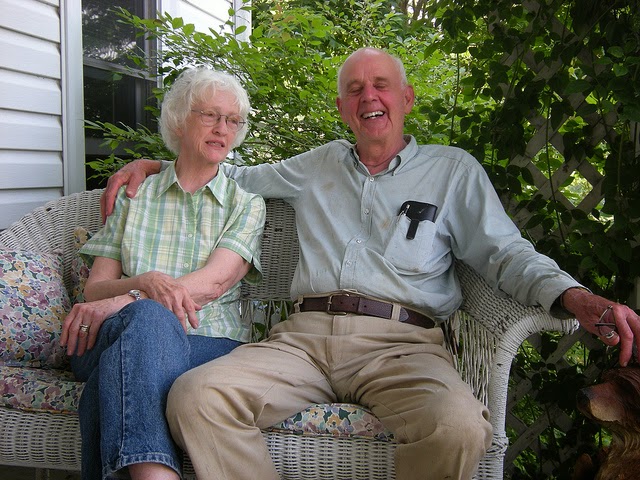 |
| Tanya & Wendell Berry Photo by Ann Thompson via Flickr |
Becoming a good steward of the earth involves learning to live, love, and tend with the land, not over or against it. It's about identifying the rhythms of life, health, and beauty already at work in nature, and partnering with it in our human culture-making, through which we create the stuff and meaning from the world we inhabit and use (channeling Andy Crouch's thinking on culture here).
And it's not a question of whether we do this culture-making and use of the world (or our relationships, such as marriage), but how, which reflects our moral character. Meador isolates what he thinks might be the heart of Berry's vision and purpose for writing as he does, with a quote from The Gift of Good Land:
“To live, we must daily break the body and shed the blood of Creation. When we do this knowingly, lovingly, skillfully, reverently, it is a sacrament. When we do it ignorantly, greedily, clumsily, destructively, it is a desecration. In such desecration we condemn ourselves to spiritual and moral loneliness, and others to want.”So it goes in creation, so it goes in marriage.
Thursday, January 1, 2015
Hope when nothing changes
From
Toledo, IA
"Nothing changes on New Year's Day" -U2 (video)
I am more than happy to bid adieu to 2014. It was a dismal year in ways both personal, societal, and global. As a recent article at Wired suggested, "2014 proved to be a year in which long-festering social, environmental, and political problems were exposed in ways we have not seen in a very long time."
That this statement appeared in Wired is itself telling, given that publication's raison d'etre, promoting the belief in progress via science and technology. It's not exactly known for its sober reflection on how those articles of faith might not actually be bringing about global progress and prosperity.
So anyway, yes: Goodbye to the year when I experienced my first psychosomatic breakdown/panic attack. Goodbye to the year that saw the parodies of justice around police brutality and racial profiling, showing how far we've not come in terms of our society's history of racism. Goodbye to the year that saw an increasing acknowledgment (thanks to folks like Naomi Klein) of the link between environmental degradation and our globalized consumer-capitalist order.
If the Christian imagination is one that should be marked by the embodied virtues of faith, love, hope, and joy (i.e. the fruits of the Spirit), then the grounds for those virtues to be cultivated in communities of Jesus' disciples seem to me to be more elusive than ever before. But maybe my sense of that is more my own white boy problems than anything. Or maybe not...
Either way, in 2015 I hope for less anxiety about personal, local, societal, and global issues (while not inoculating myself from them). I hope to be better attuned to seeing God's love for us and all creation at work, and for seeing it despite the fact that, in some very real ways, "Nothing changes on New Year's Day."
And yet marking new years is itself a sign that humans seem to be creatures prone to a rugged and resilient kind of faith and hope, seen in American culture by our various and silly "resolutions."
For my part, I resolve to be loved more freely and to love more faithfully as a child of God. Or to continue the Bono-channeling...
 |
| Trellech on New Year's Day 2009 Photo by Keith Moseley via Flickr |
That this statement appeared in Wired is itself telling, given that publication's raison d'etre, promoting the belief in progress via science and technology. It's not exactly known for its sober reflection on how those articles of faith might not actually be bringing about global progress and prosperity.
So anyway, yes: Goodbye to the year when I experienced my first psychosomatic breakdown/panic attack. Goodbye to the year that saw the parodies of justice around police brutality and racial profiling, showing how far we've not come in terms of our society's history of racism. Goodbye to the year that saw an increasing acknowledgment (thanks to folks like Naomi Klein) of the link between environmental degradation and our globalized consumer-capitalist order.
If the Christian imagination is one that should be marked by the embodied virtues of faith, love, hope, and joy (i.e. the fruits of the Spirit), then the grounds for those virtues to be cultivated in communities of Jesus' disciples seem to me to be more elusive than ever before. But maybe my sense of that is more my own white boy problems than anything. Or maybe not...
Either way, in 2015 I hope for less anxiety about personal, local, societal, and global issues (while not inoculating myself from them). I hope to be better attuned to seeing God's love for us and all creation at work, and for seeing it despite the fact that, in some very real ways, "Nothing changes on New Year's Day."
And yet marking new years is itself a sign that humans seem to be creatures prone to a rugged and resilient kind of faith and hope, seen in American culture by our various and silly "resolutions."
For my part, I resolve to be loved more freely and to love more faithfully as a child of God. Or to continue the Bono-channeling...
Say it's true, it's true
We can break through
Though torn in two
We can be one
Thursday, August 28, 2014
Willa Cather's bishop on miracles, vision, and love

"Where there is great love there are always miracles," [the bishop] said at length. "One might almost say that an apparition is human vision corrected by divine love. I do not see you as you really are, Joseph; I see you through my affection for you. The Miracles of the Church seem to me to rest not so much upon faces or voices of healing power coming suddenly from far off, but upon our perceptions being made finer, so that for a moment our eyes can see and our ears can hear what is there about us always."I was in dire need of a novel this summer and picked up this book at a great independent bookstore in downtown Chicago when my family was vacationing there last month. The book turned out to be worth its weight in gold. I had previously read Cather's My Antonia in my undergrad, and my prof for that class was a Cather scholar; so I knew I was in for goodness going into it.
And that passage above speaks to me on a number of levels...
Sunday, August 26, 2012
The providence of proximity
[Life context note: Last weekend my wife and daughter moved back to our home state of Iowa, after four years of living in lovely Harrisonburg, Virginia. I'm hanging around H'burg for a few more months to finish my work at EMU before I join them. So this weekend, I had a lot of time on my hands, and...]
With said free time I read most of the essays in Jamie Smith's The Devil Reads Derrida. Man, what a great book! It is a collection periodic essays from 2002-'07, and it is exactly the kind of intellectual writing I try to here at Restorative Theology. (Albeit with much more modest intellectual capacities than Smith's...) Here is a Christian scholar who is committed to his intellectual craft for the sake of the church and the fidelity of the body of Christ and its place in God's mission in this creation. There's all kinds of underlines in this book I made yesterday, but this little passage is too good not to post. The opening paragraph of the chapter, "The Architecture of Altruism: On Loving Our Neighbor(hood)s":
With said free time I read most of the essays in Jamie Smith's The Devil Reads Derrida. Man, what a great book! It is a collection periodic essays from 2002-'07, and it is exactly the kind of intellectual writing I try to here at Restorative Theology. (Albeit with much more modest intellectual capacities than Smith's...) Here is a Christian scholar who is committed to his intellectual craft for the sake of the church and the fidelity of the body of Christ and its place in God's mission in this creation. There's all kinds of underlines in this book I made yesterday, but this little passage is too good not to post. The opening paragraph of the chapter, "The Architecture of Altruism: On Loving Our Neighbor(hood)s":
When Jesus summarizes the "greatest commandment," it is a two-fold obligation that hinges on love: "You shall love the Lord your God with all your heart" and "You shall love your neighbor as yourself" (Luke 10:27 echoing Lev. 19:18). It is intriguing to me that when Jesus points to the centrality of love, he also invokes a metaphor which is not familial (e.g. "brother" or "friend") or ethnic (e.g. "your people"), but almost geographical: we are to love the neighbor - the one next to us, who happens (by providence) to be in proximity. The neighbor could be a friend or an enemy, a foreigner or a brother. The call to love the neighbor is a call to love all of them - that is why all of Jesus' injunctions to love are taken up in the call to love the neighbor. (Emphasis added.)This text also happened to be in the lectionary this weekend, so I heard it in the two church services I attended this weekend. (Hey...I was lonely and needed to be with my "first family.")
Wednesday, August 24, 2011
Riffing on David Brooks: Sociality, virtue, and vocation
 |
| David Brooks; Photo: Josh Haner/The New York Times |
One of my favorite Christian thinkers - philosopher, James K.A. Smith - has taken note of Brooks' recent work, going so far as to defend Brooks from those who seem to be missing his point. Plus, Brooks' work comports well with Smith's own, especially his book, Desiring the Kingdom: Worship, Worldview, and Cultural Formation. One of Smith's biggest beefs with American evangelicals is that they've been duped into the individualist-rationalist view of human nature and so only seem to explicitly care about Christians' beliefs. To counter this Smith dusts off pre-modern, classical views of human nature and virtue that account for the whole being and restore a sense of work or vocation to the Christian life.
For Christian formation to do its work, it needs to operate on our (the Church's) entire personal and collective body as well as our desires...as in desiring the kingdom of God. Smith argues that we are shaped and pointed toward certain ends (such as the fulfillment of the kingdom) by liturgies - worship, work, or just simply practices. Smith contrasts sacred liturgies (Christian worship) and secular liturgies (eg. going to the mall). To not allow the former to operate in a holistic sense allows the latter to swoop in to fill in the gap, and eventually take over as the primary formational liturgy. So well-meaning evangelicals can (and do) become functional consumerist atheists with their bodies while purporting to be Christian in terms of their beliefs. Such split-being as we've inherited from the Enlightenment is ridiculous because, after all, the mind is part of the body and knowledge also exists outside the brain, even outside our corporeal bodies (eg. social consciousness).
[This post was subsequently picked up by the Mennonite Weekly Review blog: David Brooks, John Howard Yoder, and the sociality of virtue. Thanks again to Sheldon C. Good for his editorial work!]
[This post was subsequently picked up by the Mennonite Weekly Review blog: David Brooks, John Howard Yoder, and the sociality of virtue. Thanks again to Sheldon C. Good for his editorial work!]
Tuesday, March 15, 2011
An old Brethren take on Love winning
 |
| Pastor Rob Bell (photo by feyip, CC lic.) |
 , has caused quite a stir in the U.S. Christian blogo/tweetosphere for the past few weeks, the stink getting so bad that even mainstream media has taken note and sales for the book have already been wildly successful (as of this moment it's #5 on all of Amazon). When the uproar over whether or not Bell is now preaching age-old heresy of universalism started, I immediately thought of an old Brethren teaching of "universal restoration," which sometimes got labeled (usually pejoratively) "universalism."
Last summer when I was working on my Brethren studies, I read quite a bit out of The Complete Writings of Alexander Mack. Mack was the first Brethren leader in central Germany in the early 18th century. He had a Reformed upbringing and was later influenced by Radical Pietism and a warm engagement with the Anabaptist-Mennonites around them. The movement that started out of that eventually resulted in the stream that I now stand in 300 years later, the Church of the Brethren.
Mack's belief in "universal restoration" held that hell is real, but punishment would not continue for all time, ultimately all are restored to God's love, but there was a sense of levels and those who went through hell "would never attain the high state of bliss possible to those who chose to follow Christ in life" (4).
This notion of levels of bliss helped hedge against laziness, I suppose, but Mack still cautioned: "(I)t is much better to practice this simple truth that one should try to become worthy in the time of grace to escape the wrath of God and the torments of hell, rather than deliberate how or when it would be possible to escape from it again... Even though this is true, it should not be preached as a gospel to the godless" (98-9, emphasis mine). It's worth noting that recent sociological research done by Brethren scholar, Carl Bowman, has shown this early Brethren belief to have been almost completely abandoned. Anecdotally, though, there are a few
Tuesday, October 19, 2010
The Avett Brothers' narrative doctrine of Love (and Hate)
While in sunny Florida this past spring, my friend and I - together with our wives and together without our children - crashed a small hotel room on the beach for three days. We were in town for a wedding, so the clothes strewn around the room were a mix of sand-filled swimming apparel, suit jackets, and dresses. Flip-flops and dress shoes, sunblock and makeup. Late one night, we sat down to share with each other the music that had been tripping our respective triggers in the two years since we'd moved away from each other.
One of the bands my friend introduced me to was The Avett Brothers. They ended up being a sleeper hit for me. The songs he showed me didn't really fit the celebratory mood of weddings and beaches of the moment, but into my collection they went (not them, personally, rather their latest album, I and Love and You ). There they waited. Well, this past summer their moment came, and into my heart they walked.
The past two summers have been rough for me. The rigor of graduate academic work has remained, but without the structure of the academic year. These experiences have patterned a physical response of guttural despair at the words..."independent study." Juggling that work with trying to help support the family and be a good husband and father produced some stressful, maybe even depressing, moments. In one such moment, I found myself driving up to Winchester, VA to meet with a professor. The song "Ten Thousand Words" came on and spoke to me at a level a song hadn't done for years. I must have listened to that two or three times on the way up the interstate, tears welling up from the sorry bottoms of my feet.
The rest of my family has also fallen under the Avetts' sway since then. So this past weekend, all three of us drove down to Charlottesville and saw them perform live in an outdoor venue on a beautiful fall night. During the show, Seth Avett performed a song by himself that I hadn't heard before: "The Ballad of Love and Hate," off the Emotionalism album. Here's a very good quality video of the same song performed in 2008 (It's worth switching the vid to HD and going full-screen for this one)...
Now, there are a ton of Avett Brothers songs that are just ripe for theological dialogue. In fact, I've wanted to make this post for months and had a few songs from I and Love and You in mind before hearing "Ballad..." at the show. So in the remainder of this post, I will put the lyrics out for your consideration and then do some theological dialogue with this beautiful song's doctrine (teaching) of Love and, conversely, Hate. A hint at my conclusion: It's very biblical teaching. (I don't want to load that conclusion of mine up on the Avetts; I have no idea what their faith convictions are, and I intentionally didn't go trolling around the web to try and find out, either.) So read on for more!
One of the bands my friend introduced me to was The Avett Brothers. They ended up being a sleeper hit for me. The songs he showed me didn't really fit the celebratory mood of weddings and beaches of the moment, but into my collection they went (not them, personally, rather their latest album, I and Love and You
). There they waited. Well, this past summer their moment came, and into my heart they walked.The past two summers have been rough for me. The rigor of graduate academic work has remained, but without the structure of the academic year. These experiences have patterned a physical response of guttural despair at the words..."independent study." Juggling that work with trying to help support the family and be a good husband and father produced some stressful, maybe even depressing, moments. In one such moment, I found myself driving up to Winchester, VA to meet with a professor. The song "Ten Thousand Words" came on and spoke to me at a level a song hadn't done for years. I must have listened to that two or three times on the way up the interstate, tears welling up from the sorry bottoms of my feet.
The rest of my family has also fallen under the Avetts' sway since then. So this past weekend, all three of us drove down to Charlottesville and saw them perform live in an outdoor venue on a beautiful fall night. During the show, Seth Avett performed a song by himself that I hadn't heard before: "The Ballad of Love and Hate," off the Emotionalism
album. Here's a very good quality video of the same song performed in 2008 (It's worth switching the vid to HD and going full-screen for this one)...Now, there are a ton of Avett Brothers songs that are just ripe for theological dialogue. In fact, I've wanted to make this post for months and had a few songs from I and Love and You in mind before hearing "Ballad..." at the show. So in the remainder of this post, I will put the lyrics out for your consideration and then do some theological dialogue with this beautiful song's doctrine (teaching) of Love and, conversely, Hate. A hint at my conclusion: It's very biblical teaching. (I don't want to load that conclusion of mine up on the Avetts; I have no idea what their faith convictions are, and I intentionally didn't go trolling around the web to try and find out, either.) So read on for more!
Subscribe to:
Posts (Atom)