Showing posts with label discipleship. Show all posts

Wednesday, November 27, 2013

The painful work of gratitude

From Toledo, IA
"Lead me not into..."
It's Thanksgiving week here in the U.S., and last month I agreed to speak on the topic to our local Kiwanis club meeting/lunch, which was today. For a simple, fairly informal 15-20 min. talk, I agonized over it since first receiving the invitation.

It is difficult for me to think and speak about - much less practice - being thankful in the context of our national Thanksgiving holiday. It is difficult for a range of reasons, many of which have to do with the triumph of consumerism in American life in general, but especially for the months of November and December. This relates not only to shopping but also our food system and practices. All this consumption, all this excess, all this waste, all in the name of it being "good for the economy" - and none of which makes anyone happier, healthier, or better people. To the contrary...

So my critical brain goes into overdrive during this season, quickly and easily sprinting down the paths of critique and lament. Capital-T Thanksgiving, for me, then, always has scare quotes around it.

But as a minister of the Christian faith, and the gospel/good news that Jesus announced, enacted, and invited us into - I know that (small-t) thanksgiving is a concrete expression of gratitude and should be the first thing to escape our lips when we pray to God. I also know that joy is a fruit/gift of the Holy Spirit, and one that Christians can and should embrace and embody. So yes, Lord, I am grateful; help my ungratefulness!

Tuesday, August 28, 2012

Pietist theology for civil discourse

From Harrisonburg, VA
Philipp Jakob Spener
Forefather of Pietism & neck braces
(Wikimedia)
There's a great piece over at Chris Gehrz's blog, The Pietist Schoolman, a guest post from Christian Collins Winn. Gehrz and Winn are both professors at Bethel University in St. Paul, Minnesota, and the post is Winn's address to the school's opening chapel service yesterday:

Pietism and Civil Discourse

In the piece, Winn identifies four characteristics from the Pietist tradition, specifically from its forefather, Philipp Jakob Spener, characteristics that comprise a Pietist theology for civil discourse. (Civil discourse being something that is sorely needed these days, and something I tried to model yesterday in my response to a piece by Michael Shank on Mennonites and politics.)

But here are the four characteristics with some commentary:

  1. A spirit of good faith - In virtue terms, I'd call this "charity" in the more classical sense of caritas, which connotes "costliness, esteem, affection." A related virtue would be kindness.
  2. A genuine openness to being taught - Winn rightly notes this requires the virtue of humility. We cannot assume beforehand that we are in the right, and we must always be open for the pleasant surprise of being wrong, learning something new, or understanding someone at a deeper level.
  3. A love for one's neighbor - I'll note here the brilliant quote I came across from Jamie Smith the other day: "The neighbor could be a friend or an enemy, a foreigner or a brother. The call to love the neighbor is a call to love all of them - that is why all of Jesus' injunctions to love are taken up in the call to love the neighbor."
  4. The hopeful commitment to God's peace - Hope and peace both being virtues/gifts/fruits of the Holy Spirit that, along with joy, ensure that we not become dour and spiritlessly duty-bound, where life becomes "just one damned thing after another."

Tuesday, May 29, 2012

Why "FYI evangelism" is an epic fail

From 80 Court Square, Harrisonburg, VA 22802, USA
Photo by litherland via Flickr
Story 1: When I was in my early 20s, working for a software company in Lawrence, Kansas, my boss used to call me on his daily commute from Topeka to Lawrence. He was clearly bored driving through the rural eastern Kansas landscape. (I made the same commute in reverse, as I lived in Lawrence and went to college in Topeka...I actually liked that drive.)

One morning he came into the office chuckling, saying he'd just seen something amazing on the way in. First, he passed a car with the "Jesus fish" affixed to the back of the car. Next, he saw a car sporting the "Darwin fish" (with legs, evolved; get it?!). Finally he saw a third car with the Jesus fish eating the Darwin fish! I can't quite recall but there may have even been a fourth car with some further episode in the saga, but the point remains: The "science vs. religion" battle was playing itself out before my boss's eyes, on the backs of cars. His response? Laughter. This is the only good and right response, because this form of communication sucks.

Story 2: When my 11 year-old daughter sees someone smoking, she says "Doesn't that person know they're killing themselves?" She's right; given enough time and practice, smokers are indeed killing themselves. So in the face of decades of research and anti-smoking PSA campaigns, why do people still smoke if they know it's killing them?

Thursday, February 2, 2012

#Occupying Empire: David Fitch eats and tweets at McDonald's

David Fitch,
ready for the mission field
[Note: The preface to this post's title, "#Occupying Empre" is signaling a series of posts I'll likely do this spring. More importantly it's a reference to a conference that I'm putting together with a seminary friend: #Occupy Empire: Anabaptism in God's Mission. Registration isn't open yet and speaker/schedule info is forthcoming. So this is kind of putting the cart before the horse, but stay tuned in the next two weeks for more info on the conference...]

I came across David Fitch's blog - Reclaiming the Mission - last year and began casually following his posts and his tweets. Partly by his own admissions, but also by my own assessment, Fitch seems like a postmodern evangelical whose been bit by the "new traditionalism" bug (which means he's taken folks like MacIntyre, Hauerwas, and Yoder seriously). "Neo-Anabaptist evangelical" might be another way to describe Fitch. He is a bi-vocational professor and pastor in the Chicago area. He's also not afraid to talk about Marx and Zizek, and has a provocatively-titled book, The End of Evangelicalism?, which I haven't read yet but appears in my favorite Wipf & Stock series, Theopolitical Visions. Taken together, all this makes Fitch quite an interesting person to me. Lucky for me, he's visting EMU later this month!

But one thing in particular strikes me about Fitch: He's at McDonald's a lot. I know this from his tweets. Just this morning he reported, "Gathering early at McD' s w/ triad in the back to read, pray, check in and ask the questions - ahhh discipleship :-) #fb." What's the deal?

Thursday, October 20, 2011

To faithfully #Occupy

From Eastern Mennonite University, 1200 Park Rd, Harrisonburg, VA 22802, USA
A theodoodle for occupation
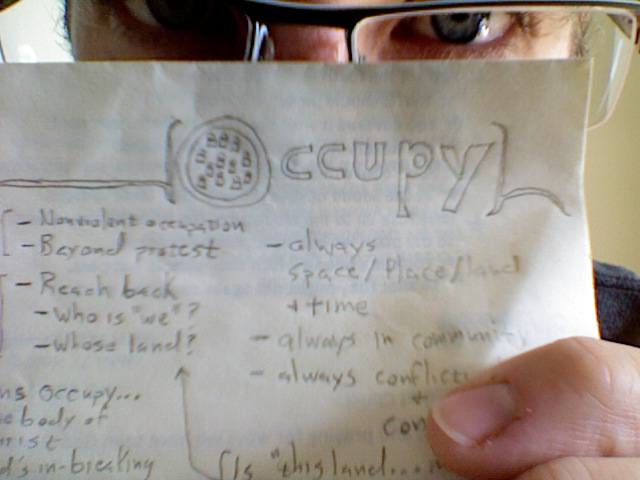
During seminary chapel worship on Tuesday, we were given a time to be reflective and write. We were supposed to write about something different than what I ended up writing about, but whatever. So here are a few theological notes and questions in relationship to the Occupy movement.

The very word "occupy" is not neutral. Occupation can have quite an oppressive connotation. The New Mexico manifestation of the movement, for instance, chose to use a different word due to "occupy's" negative connotation to indigenous Native American groups. Indeed, for indigenous peoples to this land, occupation is 300+ years of living under imposed sociopolitical orders from Europeans. Is this land really, as the song says, "made for you and me?"

So a theologically better way understand "occupy" is perhaps "inhabit," as in "to live into." So the question then becomes inhabit what? Live into where? It's important for Christians to occupy - in this sense - the body of Christ. We are its members and we seek to be healthy in that regard, to faithfully occupy the body to which we belong, and to whom we belong. In another sense, we occupy the kingdom of God as it impinges upon this world, creating it anew, slowly, agonizingly on its way to fulfillment.

But in yet another sense, we are ourselves occupied. The body is the temple of God's Spirit, both individually and corporately. We are not our own and the good that is done through us is the work of God in us. And to the extent that we perpetuate sin in this world, we are occupied by something else not of God.

Finally, occupation in a faithful sense is always embodied in time and place, and always in community. It is therefore conflictual and contingent, but therein lies the opportunity for faithfulness to be made real and shine forth a glimpse of the occupation of shalom to come. This nonviolent occupation is far beyond protest, far beyond ressentiment that (rightly so, to a point) pervades the Occupy movement underway in the U.S.

Thursday, June 23, 2011

Another sad-shocking-powerful expression of costly grace

From Eastern Mennonite University, 1200 Park Rd, Harrisonburg, VA 22802, USA
Chloe Weaver;
MWR file photo
A few months ago I theologized about a Mennonite family in Washington whose children were tragically killed in a car accident, and how the family's response was shocking to many, including the news journalist covering the story as it unfolded over years.

Last fall, 20 year-old, Chloe Weaver, met her tragic end while bicycling on a highway in Colorado, being struck from behind by a teenage boy driving a pickup truck who then fled the scene but was later identified and charged. Again, this Mennonite family's response is not typical by broadly American justice standards:

Weavers seek 'healing response' at sentencing - Sheldon C. Good, Mennonite Weekly Review


Friday, May 27, 2011

Earthy discipleship and peacebuilding in Jeremiah

From Eastern Mennonite University, Harrisonburg, VA
Photo by snowmentality (via Flickr)
Today ended a three-week intensive class at seminary, studying the book of Jeremiah in the Old Testament. It's great to have those classes where the primary textbook is the Bible, which doesn't happen as often as some might think at a seminary. For one of my papers, I chose the topic of "to pluck up and to pull down, to build and to plant," which is a theme that is established in the very first chapter and runs throughout Jeremiah, giving it somewhat of an organizing principle.

In the paper, I do a literary and narrative-theological analysis of that theme with special attention paid to historical and sociopolitical events that drive the narrative forward in Jeremiah. In an academic paper, you have to do all the hard and boring work first before you get to say the interesting and relevant stuff at the end. Since this is a blog, I'll skip most of the boring stuff and say up front why I think this theme and Jeremiah in general is an excellent source of inspiration for faithful Christian peacebuilding. If you really want to see the academic treatment, the paper will be embedded at the end. If you read both, you will see me repeating myself, because I'm lifting material from the paper for the post...

Sunday, April 24, 2011

Easter in grad school

From Eastern Mennonite University, 1200 Park Rd, Harrisonburg, VA 22802, USA
He's not here...and neither am I?
(Photo by Kodi Tanner)
Just over a month ago I wrote a post about the rhythm and rule of Christian life, aka spiritual disciplines. That post then got picked up and put on my seminary's blog. Looking back on it now, the post seems a little too confident on my part. Like I have my life together enough to be able to speak authoritatively about spiritual discipline.

Holy Week fell at an interesting time this year: right before finals. And if there's anything that the past month has shown me, it is how deeply bound I am to academic disciplines and how they enforce the rhythm and rule of my life. So Lent and Easter this year seemed as if they were playing second fiddle to grad school's bombastic tune.


Wednesday, March 30, 2011

Adventures with a Sri Lankan myth-buster

From Eastern Mennonite University, 1200 Park Rd, Harrisonburg, VA 22802, USA
In Faiths in Conflict? : Christian Integrity in a Multicultural World, Vinoth Ramachandra explores the profound challenges to the integrity of global Christian witness in the church's encounter with two major religious traditions, Islam and Hinduism, as well as the considerable forces of pluralism and secularism in their various forms. In addition to working with these challenges, Ramachandra investigates aspects of the Christian faith that not only make it unique amongst other religions, but also how those unique resources position the Christian faith to be a compelling gospel in our late modern world. Much like the Newbigin text I just reviewed, this book holds up quite well despite its being over ten years old. Especially in the final chapter on secularism and the nation-state, his reflections make use of the work of William Cavanaugh and Charles Taylor, among others, who are still very much pushing out these questions on secularism and democratic capitalism in our post-9/11, post-global economic crisis context.

What strikes me in his reflections on Islam and Hinduism is how Western myths so often rush in to provide conversational frames. With Islam for instance, the “clash of civilizations” argument forwarded by Samuel Huntington in the early 1990s has quite often been the frame for post-9/11 conversations on “Islam” and “The West.” Ramachandra dryly quips that while “Huntington's civilizational paradigm has the merit of simplicity” (15), it is precisely that merit which is the argument's greatest weakness. No civilization is as self-enclosed as Huntington proposes, for as the author states, “cultures and civilizations, far from being sealed into watertight compartments, have always interpenetrated and borrowed from each other” (22). Indeed, Muslim contributions to Western thought and earlier Christian contributions to Muslim cultures have been “largely ignored by Muslims, Western Christians and secular writers alike” (24).

Monday, March 21, 2011

The rhythm and rule of Christian life

From Eastern Mennonite University, 1200 Park Rd, Harrisonburg, VA 22802, USA
Photo by Ferran Jordà (CC lic.)
A bittersweet season of university life is drawing near: Graduation. Last year was the first time I felt this sting at EMU, as I watched my friends in the class of 2010 graduate from the Center for Justice and Peacebuilding with their MA's in Conflict Transformation, a two-year program which we'd started together in 2008. This year, many of my friends in the Seminary are graduating with their Mdiv's, a three-year program. Meanwhile, I'll be hanging around for another full year to complete my work for both degrees.

One of my fellow seminarians, Adam, was conducting a short-answer survey for his senior capstone project on the "rhythm and rule" of Christian life, a cute seminary phrase for "spiritual disciplines" or the virtuous, worshipful habits that shape our faith.  "Rhythm and rule" always makes me think of drum circles, which seems like a decent metaphor. A drum circle group that's really keyed into the rhythm is transcendant while an arhythmic circle sounds like a car crash. What do we want our lives to sound like?

Anyway, my answers to Adam's questions seemed like good material to adapt and post here, so read on for a bit of my reflections on the spiritual disciplines that have developed for this busy grad student...

Friday, March 11, 2011

Restorative or transformative theology?

From Eastern Mennonite University, 1200 Park Rd, Harrisonburg, VA 22802, USA
Howard Zehr
For the past few years I've had the joy of assisting Howard Zehr in the administration of his restorative justice blog. As I mentioned in my very first post back in October 2009, the name of this blog - Restorative Theology - takes its cue from the field that Howard helped shape over 30 years ago, a field in which I've studied and done a small amount of work. So in addition to simply helping administer, I also look at Howard's blog as a conversation partner to this one.

Howard's posts tend to be be reflective inquiries into the state of restorative justice as it's presently understood and practiced. Perhaps the primary concern in his work at this stage of his career is helping practitioners in various arenas keep true to what he sees as the values and principles of restorative justice. He's just put up an interesting post with the following query:


Read on for some of the ways in which I think a theological conversation shifts the concerns underlying such a question. I'll also make a case for restorative, transformative, and theopolitical Christian practices...

Tuesday, March 8, 2011

No villain, no hero... Just faith

From Eastern Mennonite University, 1200 Park Rd, Harrisonburg, VA 22802, USA
Periodically, stories arise from the Anabaptist traditions that shock and sometimes offend sensibilities of the broader society. Perhaps most prominent in recent American memory is the 2006 Amish school shooting at Nickel Mines, Pa., and that community's response of near-immediate loving outreach to the shooter's family. Another story that exhibits costly Christian grace comes from a Mennonite family from Chewala, Wa., whose five children were killed in a car accident five years ago. But the story doesn't end there as this piece from the local TV station details...


Monday, January 10, 2011

The Butcher's Apprentice

From Harrisonburg, VA
Photo by Andrea Nissolino
With a tentative push my index finger dug into the flesh of the pig, searching for a bundle of tendons - the "leaders" - in one of its hind legs. Got it. Tugging them out a bit, I slipped in the S-hook but my first-timer anxiety amidst the surrounding men - only one of whom I actually knew - caused me to fumble the hook and it dropped to the ground. Frustrated, I let out a groan. Behind me, the butcher gently said, "Don't worry. We learn by doing."

His name is Ike and he's an 81 year-old retired Mennonite pastor. Fifty years ago he came to this little holler at the foot of the mountains lining the western edge of the Shenandoah Valley. Many of the people around us, the locals, have known Ike since they were old enough to remember. He displayed the qualities of a wise master and for a day I was his apprentice. In the course of a day's work butchering pigs, though, he gave me much more than a lesson on the work at hand. Ike's approach to ministering to the community has for years included being the local butcher.

"When you give a sermon, people might remember a phrase or two, maybe a story you told to illustrate the Scripture. But if you come out here," Ike said gesturing at our surroundings with his knife, "people remember you. They trust you."

In this post I'll do some narrative theologizing (more narrating than theologizing) on Ike's long career as pastor/butcher, plus butchering as an analogy to the Christian faith, and finally the experience in general as a somewhat graphic illustration of the gift that is life. So you've been warned: This is not a post for those with weak intestinal fortitude (or PETA people)...

Monday, October 25, 2010

Dipping the toe to the jacuzzi that is Philosophy

From Eastern Mennonite University, Harrisonburg, VA 22802, USA
Come on in, the water is fiiiiine.
Over the course of this year, which has consisted of the end of my second year of grad school and now the beginning of the third, my theological studies led me ever-closer to the discipline of philosophy. Philosophical writing has never been far from any of my post-secondary education - whether in literature or theology - but I've never taken a formal philosophy class.

For the past few months, I've been following the writing of James K.A. Smith, who is a philosopher by trade, teaching the discipline at Calvin College. He is a self-described "theological philosopher," which basically means that he does his work in the academy making no bones that the Christian faith (in)forms his craft. The reason I've been following Smith so closely has a lot to do with the fact that he's an amazing blogger. Some of his blog posts have been seeds for essays that eventually get published in book form. So he's a line-blurrer in that regard: I don't see any of the other scholars I'm paying attention to doing their work in this way (which by virtue of this blog is obviously a way I love to work). Further, Smith's public blogging does a great job of translating the highly technical "shop talk" of philosophy into something that makes sense to someone like me. He's a fantastic Christian thinker and writer who knows his various audiences well, and speaks to them each appropriately.

So read on after the break for some quick musings on my (mis)adventures with the discipline of philosophy and how James Smith has helped me inch along...

Saturday, August 14, 2010

This Is Water in the Church

From Eastern Mennonite University, Harrisonburg, VA 22802, USA
There has been some very strange and wonderful synchronicity emerging in my social/intellectual life over the course of this year. Read on after the break to catch some glimpses inside my head and social life, as I talk about friends, literature, barefoot running, and good, contemporary Christian philosophy...

(Note: This post contains no mention of the excellent album pictured to the right.)

Friday, April 30, 2010

Live a better story

From Harrisonburg, VA, USA
Over a month ago, I met with with a staffer at EMU Campus Ministries, and they had a stack of Donald Miller's book, A Million Miles in a Thousand Years, sitting around for check-out so I grabbed one. I've had it on my shelf for a while since then but I finally got around to finishing it now that the semester is over and May term doesn't start for another week. Rather than plainly review it, I'll try to fold its essential message into some personal reflections, because it is a book that gets you thinking about how you're living your life. Read on after the break for my reflections on this great story...

Tuesday, March 30, 2010

At the end of all things normal...peace

Ten days ago, I was standing inside the house/gallery at the Ann Norton Sculpture Gardens in West Palm Beach, Florida, looking out the first floor, eastward-facing window. Outside was a small gathering of people sitting in two rows of chairs, facing the veranda just outside and to my left. Past a fountain/sculpture behind the small crowd was a smaller group of people wearing suits and dresses, preparing to walk in pairs toward the veranda, between the two rows of people. If you haven't figured it out or already knew what I was up to this day, I was in the final moments before a wedding ceremony which I was officiating. Read on after the break for my ministerial reflections on this amazing experience...

Saturday, January 30, 2010

Why can't we be friends?

In this lengthy, all-text post, I will reflect on two experiences this week that ignited no small amount of spiritual and intellectual energy in me.  If you're up to the challenge of hanging with me, read on after the break for an exploration of interfaith dialogue, psycho-social theology, and discipleship...

Sunday, November 8, 2009

What does it mean to be faithful?

During worship planning this week for church, the guiding question for our scriptural discernment became: "What does it mean to be faithful?"  Moira Rogers is a professor at EMU, in the Language & Literature Dept. and came up with a beautiful reflection to share this morning:
[Faithfulness is] accepting God’s invitation to partner with him in the creation of His New Jerusalem: a city of beauty, a city where all are welcome, a city that does not need to close its gates with fear of who may enter.

Faithfulness means raising our sight, opening our hearts and minds to God’s powerful vision for creation and for all humans, and being willing to become agents of wholeness and restoration.

Faithfulness requires of us the capacity to accept surprises that upset our orderly views of the world and become artists who ride the waves of an elusive reality gracefully, empowered by his love and guiding Spirit.
The last line is what grabbed my attention in worship: becoming "artists who ride the waves of an elusive reality..."  Wow!  What an amazing description of the almost-but-not-quite Kingdom of God!  Phew.  I threw this YouTube video together, using these words as well as music from a composer in our congregation, Jim Clemens, and some fair-use-friendly visual art from my favorite Lectionary site.

Hope you like it!

[UPDATE: Had to remove the YouTube video for some copyright concerns from Moira.]