Showing posts with label #occupy. Show all posts

Wednesday, May 23, 2012

Ecclesia and Occupy: Through a glass darkly

From 80 Court Square, Harrisonburg, VA 22802, USA
Paulette Moore speaks about Occupy Harrisonburg,
at the #Occupy Empire conference last month.
Arun Gupta has a great analysis of the Occupy movement's history (albeit brief) and current state of affairs, posted at the Al Jazeera English site: What happened to the Occupy Movement?

Especially powerful in my reading is his section, "Colonised by consumption," where he argues that the public commons has been eroded or "colonised over decades by full-spectrum consumption - shopping, eating, drinking, entertainment and paid spectacle." Occupy embodied a recreation of a public commons, enacting something different in the creation "mini-societies" within places like Zuccotti Park in Manhattan's financial district. Gupta states that:
The scene of hundreds of people exchanging food, art, music, knowledge, politics, healthcare, shelter, anger, ideas, skills and love was unlike anything else in our consumer societies - because not one exchange was lubricated by money (of course the goods were paid for at some point).
This "alternative society" aspect of Occupy is what keeps my theological interest engaged in the movement. It is in some ways a vision, as through a glass darkly, akin to what the church should look like in public: a distinct assembly (ecclesia, what we translate from Greek into "church") that lives its collective public life amidst other bodies politic.


Tuesday, April 17, 2012

Anatomy of a mini-conference

From Eastern Mennonite University, 1200 Park Rd, Harrisonburg, VA 22802, USA
Peter Dula and Chris Haw field questions from participants. (Click for more photos.)
This past weekend, seven months of shared work between my friend, Aaron Kauffman, and I came to fruition. #Occupy Empire: Anabaptism in God's Misison was by most anecdotal accounts a great success. Around 60 people converged on the Discipleship Center, perched atop the campus of Eastern Mennonite University, for 24 hours of worship, academic presentations and responses, discussion, food, and fellowship. Aaron and I started working at 8:30am on Friday and didn't stop until 7:45pm on Saturday. Having never organized a conference before, I was simply floored (almost literally) by the amount of details entailed in conducting even a small conference like this.

So despite being exhausted from end-of-semester demands for my wife and I both, which resulted in me being unable to fully engage my intellectual faculties during the conference, I still sensed that things were going quite well throughout. Logistically, things flowed smoothly, and all the intentional ways in which Aaron and I structured the conference seemed to bear the kind of fruit we had hoped and prayed for. So this post is intended to be a post mortem of sorts, assessing how well our design held up.

Sunday, April 15, 2012

#Occupy Empire in tweets

Monday, March 26, 2012

The Mennonite: "First Mennonite conference on Occupy..."

From Eastern Mennonite University, 1200 Park Rd, Harrisonburg, VA 22802, USA
Tim Nafziger
Tim Nafziger has this great piece up at The Mennonite about our upcoming #Occupy Empire conference...

First Mennonite conference on Occupy plus The American Spring

I'm grateful to Tim for getting interviews with most of the keynote speakers, to get some of their thoughts on the Occupy movement and how this conference is related (or not). It also announces the fact that we just added as a presenter, Paulette Moore, a friend and teacher of mine here at EMU who also happens to be one of the lead organizers of the local Occupy Harrisonburg (@OccupyHburg) group.


Thursday, March 8, 2012

Tales from the Enlightenment: "religious freedom"

From Harrisonburg, VA
Gather 'round, kids; grandpappy Kant has a story to tell!
For a few weeks now I've been avoiding any news media outlets - which for me are entirely online. As election season has ramped up, I noticed how even my go-to-guys - Stewart and Colbert - have become almost exclusively fixated on the ugly vetting process for the Republican presidential candidate. It's become a sort of interpretive black hole, whereby all issues are sucked into its inescapable pull and "read" in light of that incredibly nasty public spectacle. So I've switched off...kind of.

I'm still regularly on Facebook, so I continue to hear about this stuff through the various news pages that I "like" and from my friends who are following the news. A decent number of my friends are leftish peaceniks, so last week I heard a collective liberal wail of moral outrage against Rush Limbaugh for some reason or another (I happily don't know why). And the week before that it was Catholics, insurance companies, and birth control, with pictures posted of a bunch of men on a congressional panel talking about women's reproductive rights (the ironical outrage!). This issue was connected to a particular contemporary Catholic candidate for the Republican ticket and references back to a speech from an earlier Catholic candidate seeking the Democratic ticket in the early 1960s, each having various things to say about "religious freedom."

So it's that notion - religious freedom - that I want to talk about, particularly how it gets used in modern political discourse and processes. I'm riffing off a fantastic post from Saba Mahmood at the Immanent Frame blog - Religious freedom, minority rights, and geopolitics (part of a whole series of posts they have running about religious freedom) - but mostly my current reading project, Alasdair MacIntyre's After Virtue and past reading of William Cavanaugh's The Myth of Religious Violence. With these folks, I'll argue that "religious freedom" is a particular story told this side of the Enlightenment, with particular definitions given to the constituent terms "religion"and "freedom." Much like I argued last fall about the creation myth of human rights, things such as "religious freedom" and "human rights" are far from self-evident, timeless truths available to all people in all places for all times. They are, rather, contingent constructs that purport to provide something that current, dominant forms of geopolitical ordering and organizing (nation-states) are ultimately unable to deliver.

Friday, March 2, 2012

EMU News: Young Anabaptists Consider Mission in an "Occupied" World

From Eastern Mennonite University, 1200 Park Rd, Harrisonburg, VA 22802, USA
Occupy robots! (Photo by Howard Zehr)
EMU News has a nice press release up about our upcoming conference, #Occupy Empire: Anabaptism in God's Mission. Here it is...

Young Anabaptists Consider Mission in an “Occupied” World
by Laura Amstutz
Kauffman and Gumm wanted to play on and challenge the “occupy” language made popular in the last year by protesters around the country. “We wanted to reinterpret that word,” said Gumm. “We were thinking about it theologically as part of the incarnation. How can we faithfully inhabit the empire as Christians?” “We also wanted to turn it [occupy] on its head,” Kauffman added. “We are asking how God’s kingdom occupies us.”
Thanks, Laura, for a nice write-up!

Wednesday, February 29, 2012

Wringing Out Saturated Selves: Christian Education in a Secular Age

From Eastern Mennonite University, 1200 Park Rd, Harrisonburg, VA 22802, USA
This morning I gave my senior capstone presentation at Eastern Mennonite Seminary, which was based on a paper I wrote with the same name as this post. I've embedded the paper below, but let me make a few comments about the concerns animating this paper/presentation, the paper's major flow and points, and where it leads from here. I take the upcoming #Occupy Empire conference I'm helping organize as one particular project within my broader process of ministerial-vocational discernment.

In some ways, this paper and presentation marks the "philosophical turn" in my graduate studies.  This turn was precipitated by the existential and intellectual angst of being the first dual degree student at EMU's seminary and its Center for Justice and Peacebuilding. Philosophy eventually became extremely helpful in trying to adjudicate - both in terms of overlap and difference - the distinct "embodied rationalities" in those two programs. This led me to the philosophy of Charles Taylor, James K.A. Smith, and most recently, Alasdair MacIntyre.

But I've also been compelled by the biblical hermeneutic of John Howard Yoder as a way to keep me grounded in the biblical narrative as the primary "script" for my life as a ministering Christian in the body of Christ.

In my ministerial-vocational discernment these past years at grad school, I've come sense the call to being an educator in/for the church, putting the intellectual gifts which God has imbued within me to work for the sake of God's reconciling mission in the world. In testing this, I've been able to teach the same class in two radically different cultural contexts. In this paper, I try to weave all these threads together in a very short space (12 pages, 20 minute presentation). No small task.

In responding to my presentation this morning, my advisor, Mark Thiessen Nation, quipped: "What you've really done here, Brian, is lay out a research agenda for yourself." Likewise, my district executive in the Church of the Brethren described this as the start of a life-long journey. I think those assessments exactly right. There are hints in this paper to most of the influential work I've picked up and how I've been starting to assemble that toward a constructive vision for my developing vocation as a ministerial educator.

Thursday, February 16, 2012

#Occupy Empire: Anabaptism in God's Mission

From Eastern Mennonite University, 1200 Park Rd, Harrisonburg, VA 22802, USA
Scrub that dirty ol' empire away!
I hinted at it a few weeks ago. So now I'm very excited to announce that registration is now open for a mini-conference that my friend, Aaron Kauffman, and I are organizing as part of our senior capstone project at Eastern Mennonite Seminary...

#Occupy Empire: Anabaptism in God's Mission
April 13-14, 2012 - Eastern Mennonite Seminary
Anabaptism at its best has been a series of attempts both to live into God's in-breaking occupation and to faithfully occupy the empires of this fallen age, signaling the shalom to come. Anabaptists have gone about this work by imaginatively patterning their worship and witness after the New Testament communities of Jesus.

Come explore ways in which the Anabaptist tradition can help inspire faithful occupation in today's world. Interdisciplinary academic presentations will be infused with worship and testimonies to open our minds and spirits to where God is calling us into mission in the midst of empire.


Keynote speakers: Isaac Villegas, Chris Haw, Nekeisha Alexis-Baker, and Janna Hunter-Bowman. (See full list of speakers.)

Thursday, February 2, 2012

#Occupying Empire: David Fitch eats and tweets at McDonald's

David Fitch,
ready for the mission field
[Note: The preface to this post's title, "#Occupying Empre" is signaling a series of posts I'll likely do this spring. More importantly it's a reference to a conference that I'm putting together with a seminary friend: #Occupy Empire: Anabaptism in God's Mission. Registration isn't open yet and speaker/schedule info is forthcoming. So this is kind of putting the cart before the horse, but stay tuned in the next two weeks for more info on the conference...]

I came across David Fitch's blog - Reclaiming the Mission - last year and began casually following his posts and his tweets. Partly by his own admissions, but also by my own assessment, Fitch seems like a postmodern evangelical whose been bit by the "new traditionalism" bug (which means he's taken folks like MacIntyre, Hauerwas, and Yoder seriously). "Neo-Anabaptist evangelical" might be another way to describe Fitch. He is a bi-vocational professor and pastor in the Chicago area. He's also not afraid to talk about Marx and Zizek, and has a provocatively-titled book, The End of Evangelicalism?, which I haven't read yet but appears in my favorite Wipf & Stock series, Theopolitical Visions. Taken together, all this makes Fitch quite an interesting person to me. Lucky for me, he's visting EMU later this month!

But one thing in particular strikes me about Fitch: He's at McDonald's a lot. I know this from his tweets. Just this morning he reported, "Gathering early at McD' s w/ triad in the back to read, pray, check in and ask the questions - ahhh discipleship :-) #fb." What's the deal?

Tuesday, November 1, 2011

The occupation of policing social movements

From Eastern Mennonite University, 1200 Park Rd, Harrisonburg, VA 22802, USA
Conversation at Occupy Chicago
(Photo by Michael Kappel via Flickr)
James Cavanaugh, a retired ATF executive, offers a good picture of the role of police in the #occupy movement in this op-ed piece posted to Tickle the Wire, a site focused on federal law enforcement.

Most notably, he encourages the "greatly underutilized" resources of police negotiators to form relationships and build trust with #occupy movement leaders, and to coordinate plans on a day-to-day basis. As Cavanaugh states, "It does not mean that the police will do everything that the protesters want, but it insurers that police will not act without first building trust and communication."

This to me seems right on. Part of the problem I've seen in citizen coverage of police presence in the #occupy movement is the militarized/SWAT stance. Granted, there is also a problem with how many in the movement view and antagonize police (including in said citizen coverage), so it's not like protesters are lily white. Less emphasis should placed on militarized police forces and more placed on building collaborative relationships with protesters, and a segment of protesters should stop demonizing the police. Such moves could encourage an already mostly-nonviolent movement to stay that way, and keep them on course toward substantive change.

Thursday, October 20, 2011

To faithfully #Occupy

From Eastern Mennonite University, 1200 Park Rd, Harrisonburg, VA 22802, USA
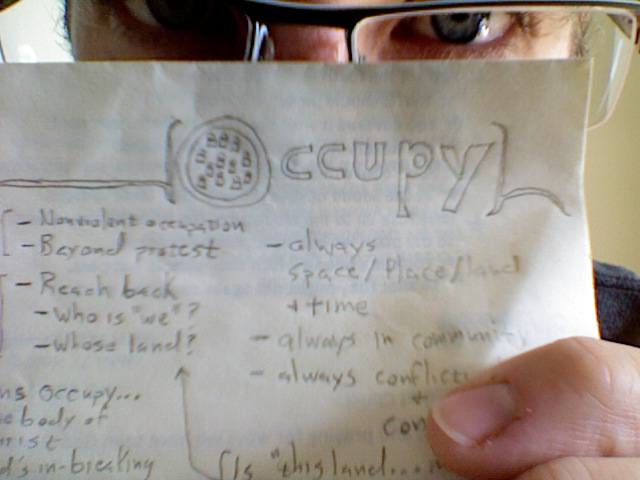
A theodoodle for occupation
During seminary chapel worship on Tuesday, we were given a time to be reflective and write. We were supposed to write about something different than what I ended up writing about, but whatever. So here are a few theological notes and questions in relationship to the Occupy movement.

The very word "occupy" is not neutral. Occupation can have quite an oppressive connotation. The New Mexico manifestation of the movement, for instance, chose to use a different word due to "occupy's" negative connotation to indigenous Native American groups. Indeed, for indigenous peoples to this land, occupation is 300+ years of living under imposed sociopolitical orders from Europeans. Is this land really, as the song says, "made for you and me?"

So a theologically better way understand "occupy" is perhaps "inhabit," as in "to live into." So the question then becomes inhabit what? Live into where? It's important for Christians to occupy - in this sense - the body of Christ. We are its members and we seek to be healthy in that regard, to faithfully occupy the body to which we belong, and to whom we belong. In another sense, we occupy the kingdom of God as it impinges upon this world, creating it anew, slowly, agonizingly on its way to fulfillment.

But in yet another sense, we are ourselves occupied. The body is the temple of God's Spirit, both individually and corporately. We are not our own and the good that is done through us is the work of God in us. And to the extent that we perpetuate sin in this world, we are occupied by something else not of God.

Finally, occupation in a faithful sense is always embodied in time and place, and always in community. It is therefore conflictual and contingent, but therein lies the opportunity for faithfulness to be made real and shine forth a glimpse of the occupation of shalom to come. This nonviolent occupation is far beyond protest, far beyond ressentiment that (rightly so, to a point) pervades the Occupy movement underway in the U.S.